
文献阅读 Summary Level Training of Sentence Rewriting for Abstractive Summarization
1 Introduction
Title : Summary Level Training of Sentence Rewriting for Abstractive Summarization Link : http://arxiv.org/abs/1909.08752 Author : Sanghwan Bae, Taeuk Kim, Jihoon Kim and Sang-goo Lee Conference : Proceeding of the 2nd Workshop on New Frontiers in Summarization (held by EMNLP)
1.1 Achievement
- Present a novel training signal that directly maximizes summary-level ROUGE scores through reinforcement learning
- Obtains new state-of-the-art performance on both CNN/Daily Mail and New York Times datasets[1]
[1] Actually, the result of (Liu, 2019) is now state-of-the-art.
2 Method
2.1 Extractor
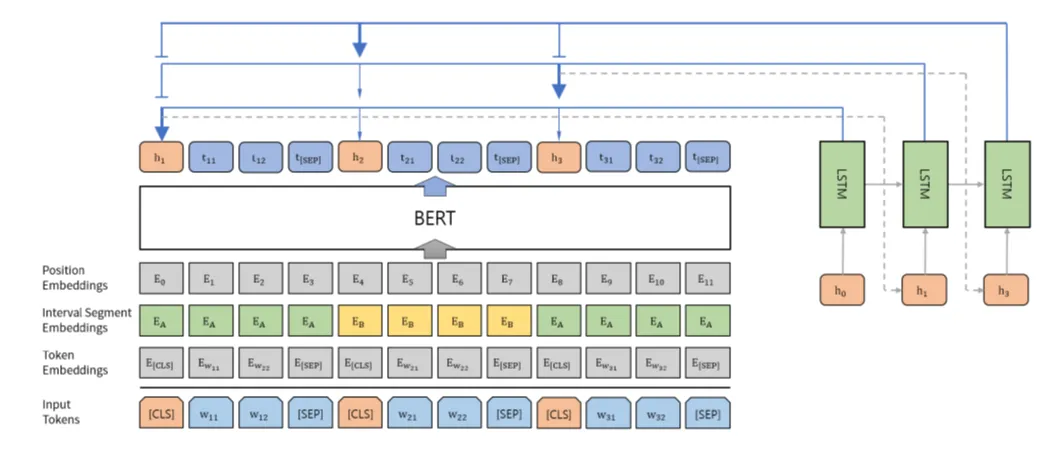
Requirement : Input with document sequence D and output with the chosen extractive sentence subset
Solution : (Sequence D -> BERTSUM (Encoder) -> LSTM Pointer Network (Decoder))
- Input the sentence vector into BERTSUM[1] in which they use BERT BASE, a small version of BERT LARGE
- Feed the sentence representation vector H into the LSTM Pointer Network[2] with 256 hidden size
Advantage :
- Enable the decoder to consider the previous selected sentence
- Avoid information overlapping between the selected sentences
[1] Text Summarization with Pretrained Encoder, 2019 [2] Pointer networks, 2015
2.2 Abstractor[1]
Requirement : Input with selected extractive sentence subset and output with the corresponding paraphased sentence
Solution : (extractive sentence subset -> seq2seq model)
- Use word2vec[2] model of 128 dimensions
- Feed extractive sentence subset modified by word2vec into seq2seq[3] model which use copying mechanism[4] for handling out-of-vocabulary words
[1] Fast Abstractive Summarization with Reinforce-Selected Sentence Rewriting, 2018 [2] Distributed representations of words and phrases and their compositionality, 2013 [3] Neural machine translation by jointly learning to align and translate, 2015; Effective approaches to attention-based neural machine translation, 2015 [4] Get to the point: Summarization with pointer-generator networks, 2017
3 Training
3.1 Extractor Pre-training[1]
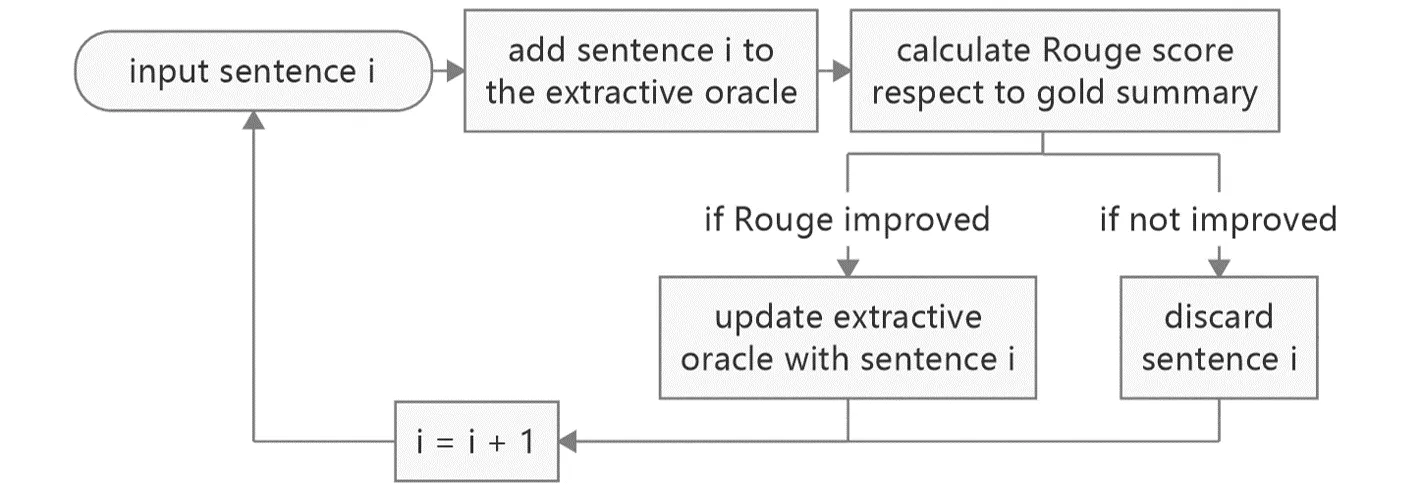
Requirement : Selected sentences should be the ones that maximize the Rouge score with respect to gold summaries
Problem :
- Most summarization corpora only contain human written abstractive summaries as ground truth (No extractive summary for training)
- It is computationally expensive to find a globally optimal subset of sentences that maximizes the Rouge score
Solution :
- Add the document sentence to the extractive oracles until the remaining candidate can’t improve the Rouge score with respect to entire gold summary
- Train the extractive model with cross-entropy
[1] Summarunner: A recurrent neural network based sequence model for extractive summarization of documents, 2017
3.2 Abstractor Training
Requirement : Find the proper paraphrased function between original sentence and the gold summary
Solution :
- For each ground truth summary sentence, find the most similar sentence in the original document with Rouge score
- Train the model as a usual seq2seq model with cross-entropy
3.3 Reinforcement Learning Optimization
Requirement : Optimize the Rouge metric
Solution : Assume the extractor as an agent in reinforcement learning paradigm
Not quite understand yet.
4 Result
Their Rouge score is worse than the score of (Liu, 2019) .
5 Comparison and Conclusion
In this paper :
- Extractor : BERTSUM (Encoder) + LSTM (Decoder)
- Abstractor : seq2seq
In (Liu, 2019) :
- Extractor : BERTSUM (Encoder) + Transformer + sigmoid classifier (Decoder)
- Abstractor : 6 layered Transformer
Conclusion : Seems that Transformer in (Liu, 2019) performs better than seq2seq in this paper