
文献阅读 Text Summarization with Pretrained Encoder
1 Introduction
Title : Text Summarization with Pretrained Encoder Link : http://arxiv.org/abs/1908.08345 Author : Yang Liu, Mirella Lapata Conference : Accepted by EMNLP2019 Code : https://github.com/nlpyang/PreSumm
1.1 Achievement
- Test the feasibility of BERT in text summarization
- Build a general framework with extractive model and abstractive model
- Propose a two-stage fine-tuning approach
2 Method
2.1 BERTSUM
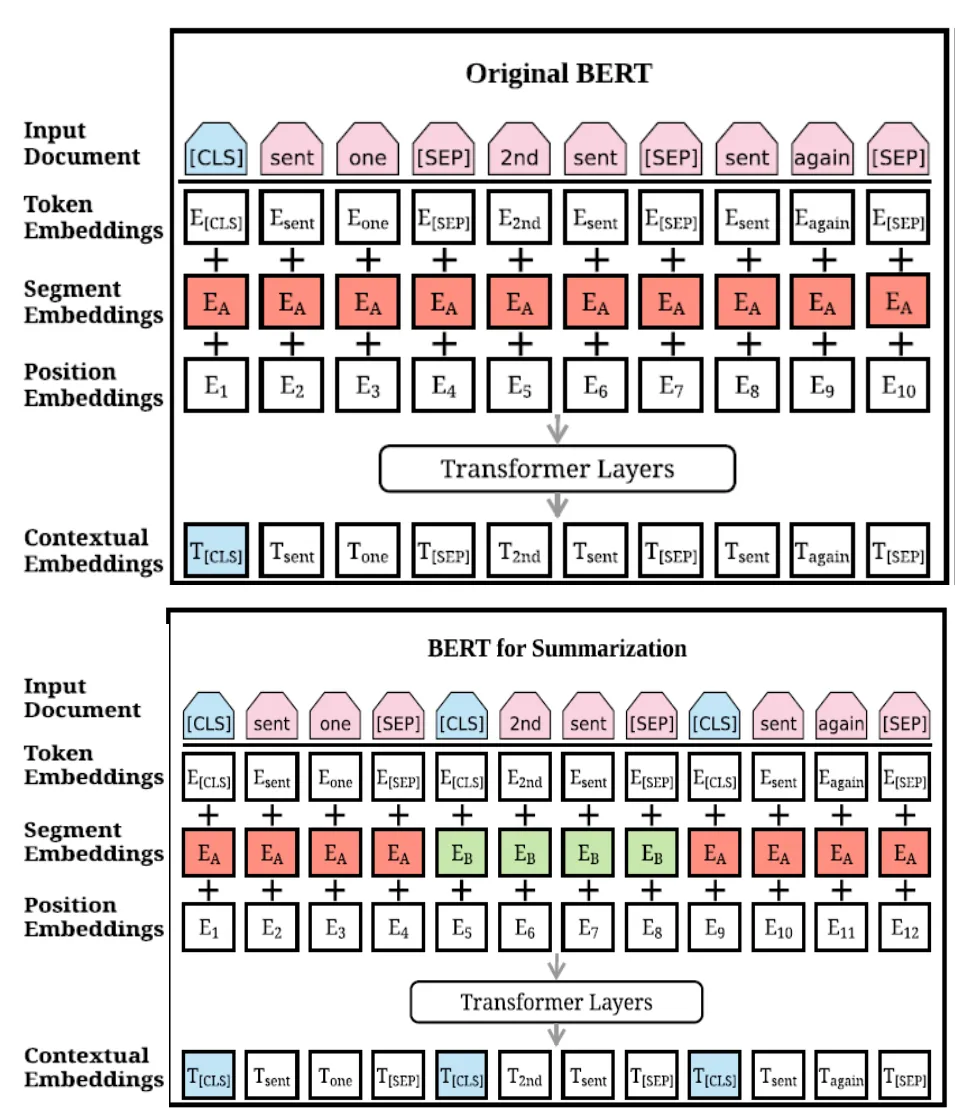
Problem : Original BERT[1] can only apply to single sentence/sentence-pair input
Requirement : Input with multiple sentences and output the contextual embeddings
Solution : (Modified BERT)
- Insert [CLS] tokens at the start of every separate sentence to collect the feature of the following[2] sentence
- Use crossing segment embeddings[3] EA and EB to distinguish multiple sentences in a document
[1] BERT: Pre-training of Deep Bidirectional Transformers for Language Understanding, 2019 [2] In the original BERT, [CLS] symbol only appear at the start of the document for text classification. In this paper, the author said [CLS] is used for collecting the feature of the preceding sentence. However, it seems that the [CLS] symbol is actually used for collecting the feature of the following sentence. [3] In the original BERT, EA and EB are also used but limited by one sentence-pair. In this paper, EA and EB are expanded to the whole word embedding.
2.2 BERTSUMEXT[1]
Requirement : Input with sentence representation and output the chosen extractive summary subset
Solution : (BERTSUM -> Transformer -> Sigmoid Function)
- Use the contextual embedding of the [CLS] symbol as the sentence representation
- Use a L-th layer Transformer to collect document-level features for extracting summaries (L = 2 performs best)
- Output the binary result {0, 1} (1 for included) with a sigmoid function at the end
[1] Attention is all you need, 2017
2.3 BERTSUMABS[1]
Requirement : Input with sentence representation and output with abstractive summary
Solution : (BERTSUM -> Transformer)
- Use the contextual embedding of the [CLS] symbol as the sentence representation
- Use a 6-layered Transformer as the decoder to generate the abstractive summary
[1] Get to the point: Summarization with pointer- generator networks, 2017
2.4 BERTSUMEXTABS[1][2]
Requirement : Input with sentence representation and output with abstractive summary
Solution : (BERTSUM -> Extractor Transformer -> Abstractor Transformer)
- Use the contextual embedding of the [CLS] symbol as the sentence representation
- Use a L-th layer Transformer to collect document-level features for extracting summaries (L = 2 performs best)
- Output the binary result {0, 1} (1 for included) with a sigmoid function at the end
- Use a 6-layered Transformer to paraphrase the extracted sentence into the abstractive summary
Advantage :
- Extractive summary can boost the performance of abstractive summarization
- This two-stage approach with extractor and abstractor can share the information between them
[1] Bottom-up abstractive summarization, 2018 [2] Improving neural abstractive document summarization with explicit information selection modeling, 2018
3 Experiment Result
3.1 CNN/DailyMail[1]
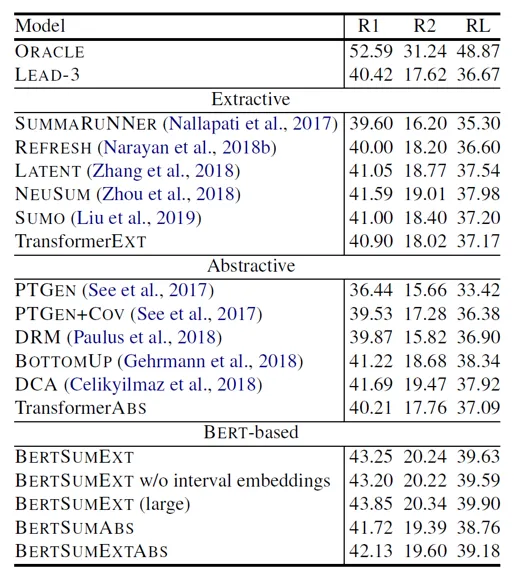
[1] Using the split of Teaching machines to read and understand, 2015
3.2 NYT[1]
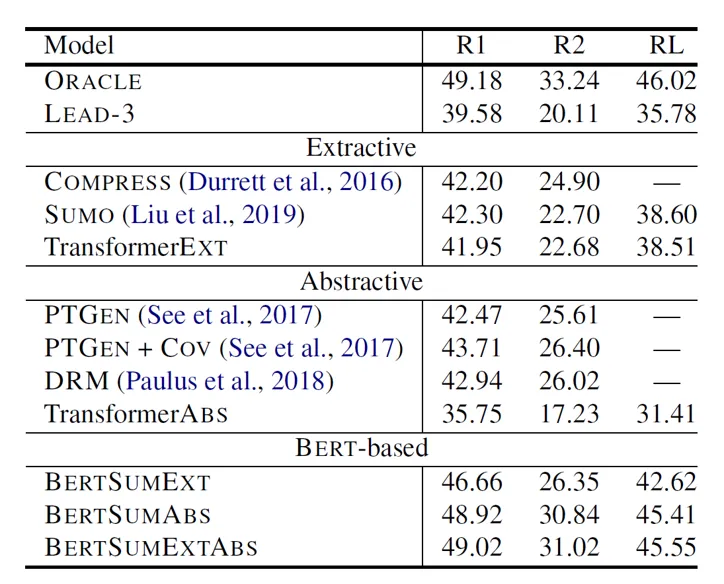
[1] Following Learning-based single-document summarizationwith compression and anaphoricity constraints, 2016
4 Conclusion
- Apply pre-trained BERT in text summarization
- Introduce document-level encoder (BERTSUM)
- Propose a framework for extractive and abstractive summarization (BERTSUMEXTABS)
- Achieve state-of-the-art on dataset